
What to Say on a First Date When Your Mind Goes Blank

What you actually do about a blank mind depends entirely on where it happens. Live, in person, you can't reach for any tool mid-sentence, so the only real fix is a couple of short, pre-rehearsed recovery lines. In a text before or after the date, you're in a genuinely different situation, one where real-time help actually exists.
A blank-mind moment on a date is a brief lapse where anxiety temporarily blocks your ability to generate conversation, and the right response depends on whether it happens live, in person, or in a text.
Most advice on this topic treats every blank moment the same way. It isn't. What works at the table is useless in a text thread, and what works in a text thread is impossible to use at the table.
TL;DR
- What to say when you go blank depends on where it happens: live in person, or in a text before or after the date.
- Live, in person, you can't pull out an AI tool mid-sentence, so the only real fix is a small set of pre-rehearsed recovery lines that don't require improvising from nothing.
- In text, before or after the date, you actually can get real-time help, which is a genuinely different situation than a live blank-out.
- A good recovery line doesn't need to be clever. It just needs to buy a few seconds and hand the conversation back to the other person.
- Naming the pause out loud ("Sorry, I lost my train of thought for a second") tends to work better than people expect, because it's honest instead of stiff.
- The real long-term fix isn't a better line. It's rehearsing recovery moments in advance so retrieving one takes less effort under pressure.
- Don't treat every blank moment as a crisis. A short pause reads as normal to almost everyone except the person having it.

What Actually Happens When Your Mind Goes Blank on a Date?
Going blank is a brief lapse, not a real failure. Anxious thoughts compete for the same limited mental space your brain needs to generate conversation, which is the same mechanism behind why nerves make small talk feel so hard in the first place.
What's different here is the moment itself, not the cause. This is about the few seconds right after it happens, when you have to actually do something, not just understand why it's occurring.
That's where the medium matters more than almost anything else. What you can realistically do next changes completely depending on whether you're sitting across from someone or looking at your phone.
Why Does It Matter Whether You're Live or Texting?
Live, at the table, there's no buffer and no tool to reach for. Whatever you say next has to come from what's already rehearsed and available in your head, because the moment doesn't pause for you to think.
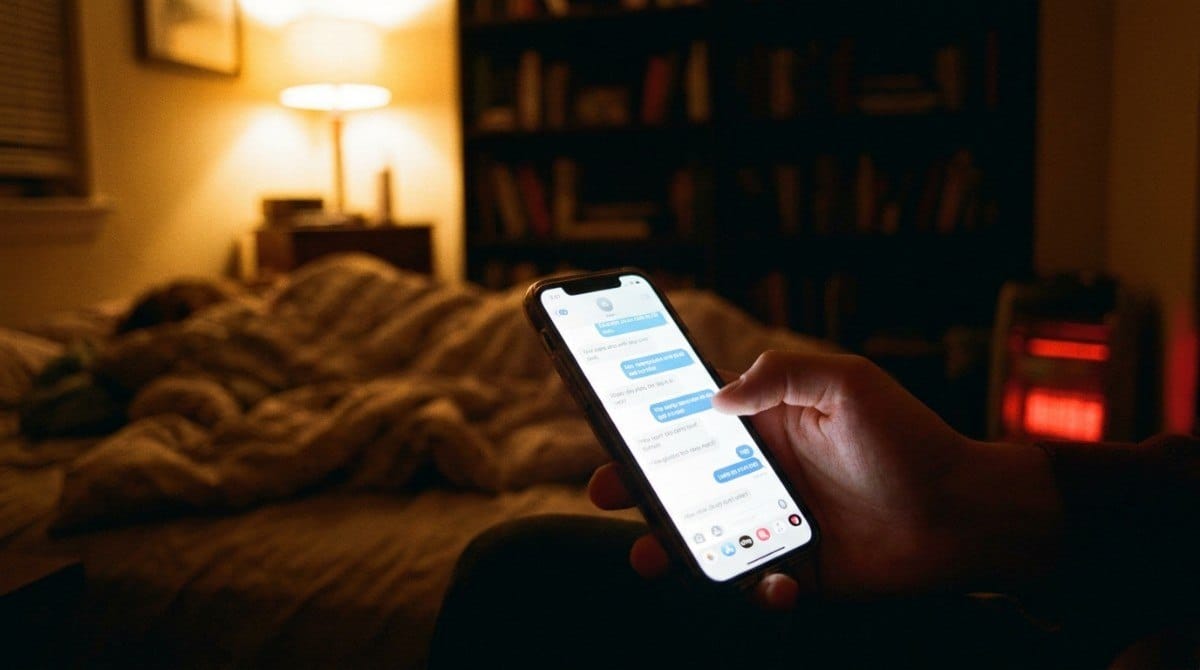
In a text, before the date while you're confirming plans, or after while you're figuring out how to follow up, the buffer still exists. You can pause, think, and if you want it, get a real-time suggestion for what to say next, the same way DatingX's Replier works inside an active conversation.
That distinction is the whole point of this article. Treating both moments the same way is why most "what to say" advice falls flat. One moment needs something already in your head. The other can actually use a tool in the moment.
What Should You Actually Say When You Go Blank in Person?
At the table, the goal isn't a clever line. It's buying a few seconds and handing the conversation back to the other person, without making the pause feel bigger than it is.
A few options that actually work, said naturally rather than recited:
- Name it honestly. "Sorry, I completely lost my train of thought, what were you saying?" This works because it's true, and most people find it disarming rather than awkward.
- Redirect to something they already said. "Wait, going back, what was that thing about [something from earlier]?" This uses a real detail instead of inventing a new topic from nothing.
- Use the environment as an anchor. "Random, but this place has a good vibe, have you been here before?" A visible, shared detail is easier to reach for than an abstract new topic.
- Buy a beat with a small action. Take a sip of your drink, then ask a simple, low-effort question. The pause reads as natural, not panicked.
None of these require memorizing exact wording. They're categories of response, the same principle behind rehearsing recovery moments in advance so one of them is already close to automatic when you need it.
Blank-Mind Moment: Live vs. Text
| Medium | Can You Get Real-Time Help? | What Actually Works | Best Prep |
|---|---|---|---|
| Live, in person | No, nothing to reach for mid-sentence | A few short, pre-rehearsed recovery lines | Rehearsing recovery moments in advance |
| A text before or after the date | Yes, you can pull up help in the moment | A quick, real-time suggested reply | A live tool built specifically for that moment |
If you want the live-moment recovery lines to feel automatic instead of invented on the spot, DatingX's Practice mode runs a live voice conversation built for exactly that kind of rehearsal.
What Happens If You Go Blank in a Text Instead?
This is the moment most "what to say" advice ignores entirely, and it's actually the easier one to solve. If you're staring at a text before or after the date, unsure how to respond, you don't need a memorized line. You have time.
That's the specific gap a live tool fills. Paste the conversation, get a suggestion built around the actual tone and momentum of what's already been said, rather than a generic response that ignores context, which is also worth pairing with keeping the conversation going without forcing it once the initial blank moment passes.
Statistics & Research Insight
The reason rehearsal specifically helps the live, in-person version of this problem comes down to a well-documented concept called automaticity. Research on skill practice consistently shows that repeated practice doesn't just make a response faster, it measurably reduces the cognitive load required to produce it.
In plain terms, a rehearsed recovery line takes less mental effort to retrieve than one you're generating from scratch, which matters enormously in a moment when anxiety is already occupying a chunk of that same mental capacity.
This is also why memorizing a single script doesn't hold up as well as rehearsing a small set of flexible categories. A single exact line has one retrieval path, and if anxiety blocks it, there's nothing else automatic to fall back on. A practiced category of response, said in your own words, has several.
Key Insight: The fix for going blank live isn't a better line, it's a rehearsed one, because practiced responses require less mental effort to retrieve exactly when anxiety is eating into that effort the most.

How to Actually Recover When Your Mind Goes Blank
- Pick two or three recovery categories, not exact lines. Naming the pause, redirecting to something they said, and using the environment cover most situations.
- Practice them out loud before the date, not just in your head, so retrieving one takes less effort under pressure.
- If it happens live, use the shortest option first. Naming the pause honestly is almost always enough on its own.
- If it happens in a text, take the time you actually have. There's no need to rush a reply the way you would a live pause.
- Don't apologize repeatedly. One honest acknowledgment is enough. More than that draws attention to it.
- Treat it as normal after it happens, not something to replay. A two-second pause is rarely as noticeable to the other person as it feels to you.
When NOT to Use This
Don't over-rehearse exact lines for the live moment. The point is flexible categories you can reach for, not a script, which collapses under the same pressure a memorized opener does.
Don't lean on a text tool to avoid the live conversation altogether. The two moments are different, and a live tool for texts isn't a substitute for having something ready at the table, similar to the caution covered in what happens if you rely on AI practice instead of showing up prepared.
And if blanking out happens constantly, in nearly every social situation, not just dates, that's worth mentioning to a professional. This advice is built for situational nerves, not a broader pattern.
Final Takeaway
Going blank isn't a sign the date is going badly. It's a brief, normal lapse, and the fix depends entirely on where it happens: a rehearsed line at the table, or a real-time suggestion in a text. Knowing which moment you're actually in is most of the battle.

This is one of the few moments where two different DatingX tools actually solve two different problems, and it's worth being specific about which one fits which.
For the live moment, at the table: there's nothing to open on your phone, so the only real preparation is rehearsal. DatingX's Practice mode runs a live, unscripted voice conversation built to help recovery lines feel automatic instead of invented on the spot, so when a pause happens, you already have somewhere to go.
For the text moment, before or after the date: you actually have time, and that's exactly what DatingX's Replier is built for. Paste the conversation, and it suggests a reply built around the real tone and momentum of what's already been said, rather than a generic line that ignores context.
Why the two-tool approach actually matches the problem:
- 🎙️ Practice builds automatic recovery for the moment you can't reach for a tool
- 💬 Replier gives real-time help for the moment you actually can
- 📱 Both live in the DatingX app, so the right one is available whichever moment you're in
If you're not sure which one you need right now, start with a live practice session to build the recovery habit, then download DatingX and 10x your dating game.
FAQ
1. What should I say when my mind goes blank on a first date? Name the pause honestly ("Sorry, I lost my train of thought"), redirect to something they already said, or use something in the environment as a natural anchor. Any of these buys a few seconds without needing a clever line.
2. Is it normal to blank out during a first date? Yes. It's a brief, common lapse caused by anxious thoughts competing for the same mental space needed to generate conversation, not a sign the date is going badly.
3. What's a good recovery line if I lose my train of thought mid-conversation? A simple, honest acknowledgment works best: "Sorry, I lost my train of thought for a second, what were you saying?" It's disarming because it's true, not because it's clever.
4. Can AI help if I go blank while texting before or after a date? Yes. Unlike a live, in-person blank-out, a text gives you time, which is exactly the situation a tool like DatingX's Replier is built for, suggesting a reply based on the real conversation so far.
5. How do I prevent going blank on a date in the first place? Rehearse a small set of flexible recovery categories out loud before the date. Practiced responses require less mental effort to retrieve than ones generated from scratch, which matters most exactly when anxiety is highest.