
Are AI Dating Chatbots Cheating? What Real Daters Actually Think (2026)

The honest answer is: using an AI dating chatbot to refine a message is not cheating, but using it to misrepresent who you are crosses a line most real daters won't accept. The category isn't deceptive by default; specific uses of it are. The line is more concrete than the "is AI fake?" debate makes it sound.
This article gives the relational ethics most reviews dodge: the 3-question test that determines when AI use is fair vs. deceptive, the specific lines that actually cross with real daters, and what people surveyed in 2026 said when asked directly.
TL;DR
- AI dating chatbots aren't categorically cheating, but specific uses cross relational lines
- The 3-question test: Are you misrepresenting who you are? Could you say this yourself? Would you tell them if asked?
- Real-dater surveys consistently show ~60–70% accept AI for editing and refinement, with sharp drops when copying verbatim or fabricating personality
- The "cheating" frame is mostly inherited from school plagiarism rules and doesn't map cleanly to dating
- DatingX and other co-pilot tools are designed for the fair-use side of the line; companion AI raises a different fidelity question entirely

Where The "Cheating" Frame Comes From (And Why It's Misleading)
The instinct to call AI dating tools "cheating" is mostly inherited from school plagiarism rules: using a tool you didn't credit equals dishonesty. But dating isn't an exam. The point isn't to demonstrate independent capability under controlled conditions, the point is to communicate honestly with another person.
Once that frame shifts, the question stops being "did you use AI?" and becomes "did you misrepresent yourself?" Those aren't the same question, and conflating them is how this debate stays stuck.
For the related but distinct question of whether AI changes your sense of yourself, the dedicated authenticity analysis is the better entry point. This article focuses on the other person's perspective.
What Counts As Cheating In Dating Anyway?
A useful distinction. There are three traditional definitions of cheating in a romantic context.
- Sexual or emotional infidelity inside an existing relationship. Universally accepted as cheating.
- Deception about who you fundamentally are (lying about marital status, age, intentions, identity). Universally accepted as cheating.
- Using a tool, friend, or external help to communicate. Almost never called cheating, in any other context.
AI dating tools fall into the third category by default. The "cheating" framing only applies if specific uses cross into the second category, which is where the ethical line actually lives.
The 3-Question Ethical Test
This is the practical test. If you can answer "no" to all three, your AI usage is fair. If you answer "yes" to any of them, you're crossing a line.
Question 1: Are You Misrepresenting Who You Are?
The core question. Is the AI making you sound like a different person, or is it polishing how you already sound?
Fair use: Using AI to find a sharper version of a message you'd already write. Using it to fix awkward phrasing. Using the chat decoder to confirm what a message means before responding.
Crosses the line: Using AI to fake a personality (witty when you're not, confident when you're not, knowledgeable about topics you've never studied). The other person isn't matching with the real you, they're matching with the AI's projection of you.
The test: if you met in person tomorrow, would the in-person you match the texted you? If yes, fair. If no, you've crossed the line.
Question 2: Could You Say This Yourself?
A simpler version of question 1, applied at the message level.
Fair use: AI suggests a line you could plausibly have written, you edit it slightly, you send it. The thought is yours, the polish is the tool's.
Crosses the line: AI generates an entire personality on your behalf — clever banter you couldn't recreate in person, vocabulary you never use, references to things you don't actually know. Sending that as your own creates a date you'll struggle to honor.
The test: if asked to explain what you sent, could you defend it as your own thinking? If yes, fair. If no, the AI is dating for you.
Question 3: Would You Tell Them If Asked?
The disclosure test. This is the strongest single filter.
Fair use: If your match asked "did AI help with that?", you'd say "yeah, sometimes I use a tool to polish openers" without flinching. Same way you'd admit a friend helped you draft a difficult text.
Crosses the line: If your match asked the same question and you'd lie or panic, the use isn't fair. The instinct to hide is the signal.
The test: if you wouldn't comfortably disclose, you've already labeled it as deception in your own head.

What Real Daters Actually Think (2026 Survey Data)
Public 2026 surveys on AI in dating consistently show a calibrated, not absolutist, response from real daters. The pattern is similar across multiple datasets.
| AI Usage | % of Daters Who Say "It's Fine" | % Who Say "It's Cheating" |
|---|---|---|
| Using AI to polish an opener | ~70% | ~10% |
| Using AI to suggest replies you edit | ~60% | ~15% |
| Using AI to decode confusing messages | ~75% | ~5% |
| Copying AI suggestions verbatim | ~25% | ~50% |
| Letting AI generate personality you don't have | ~10% | ~70% |
| Using companion AI while dating real people | ~30% | ~45% |
The pattern is clear: real daters draw the line not at AI use, but at AI substitution. Refinement is broadly accepted. Replacement is broadly rejected. The ethical instinct in the population mirrors the 3-question test almost exactly.
Key Insight: Real daters don't think AI is cheating. They think misrepresentation is cheating, and AI is one of many tools that can be used either way. Polishing how you already sound is fine. Fabricating who you are isn't. The tool is neutral; the use isn't.
For the deeper structural framing of why this distinction matters, the Atrophy vs. Augmentation framework for AI dating tools maps the same dynamic from a skill-building angle.
The 4 Specific Uses That Real Daters Consider Cheating
These are the patterns that consistently fail the 3-question test in survey data.
1. Faking Personality Through Witty AI Banter
The most-cited objection. Sending banter you couldn't generate in person creates a date the in-person you can't deliver on. The disconnect between texted-self and real-self is what daters resent, not the AI itself.
2. Misrepresenting Knowledge Or Interests
Using AI to discuss topics you don't actually understand (philosophy, art, books you haven't read, hobbies you don't have). The other person is investing in a version of you that doesn't exist outside the chat.
3. AI-Generated "Vulnerability"
Using AI to manufacture emotional disclosure or depth you haven't actually felt. This one ranks especially high in surveys because it weaponizes the other person's empathy against fabricated emotion.
4. Running Multiple Conversations Through The Same AI Persona
When the same AI-generated voice is texting dozens of matches simultaneously, the personalization becomes generic in a way matches eventually notice. It also signals quantity over genuine interest.
When AI Use Is Clearly Fair (No Ethical Question)
These are the patterns that pass the 3-question test cleanly and which most surveyed daters explicitly accept.
- Polishing your opener. Same category as a friend reading it before you send.
- Fixing awkward phrasing on a message you wrote yourself. Spellcheck-adjacent.
- Decoding confusing messages. No deception involved; the AI is helping you understand, not project.
- Practicing for a date in advance. The voice-based date practice at practice.datingx.ai is rehearsal, not deception.
- Generating multiple opener variations to find the one that sounds like you. The selection is yours; the AI just expands the menu.
- Translating tone (e.g., your message reads too aggressive; AI helps soften it).
If your AI use lives in this list, the ethical question doesn't really apply.

What About Companion AI? (A Different Ethical Question)
Companion AI raises a different question entirely. Using a co-pilot tool while dating real people is communication assistance. Using a companion AI (an AI partner you're emotionally engaged with) while in a real relationship is closer to a fidelity question than a communication question.
Surveys consistently show ~45% of partnered respondents consider sustained companion-AI use a form of emotional infidelity, and another ~30% say "it depends on disclosure." The broader analysis of why people are dating AI chatbots instead of real people covers this dynamic in detail.
Two cleanly different questions:
| Question | Ethical Frame | Verdict |
|---|---|---|
| "Is using a co-pilot AI to text my match cheating?" | Communication ethics | No, unless misrepresentation occurs |
| "Is having a companion AI while in a relationship cheating?" | Fidelity ethics | Often yes; depends on disclosure and partner agreement |
Lumping them together is the most common confusion in this debate.
Quick Framework: Is What You're Doing Fair?
A fast 4-step check.
- Run the 3-question test. Misrepresenting? Could you say it yourself? Would you disclose if asked?
- Compare your texted self to your real self. If the gap is small, you're fine. If it's a chasm, recalibrate.
- Check the disclosure instinct. If you'd comfortably tell your match, the use is fair. If you'd hide it, it isn't.
- Audit the substitution risk. Are you using AI to refine your voice, or to generate a voice you don't have? The first is augmentation. The second is replacement.
If all four check out, you're well within the line most real daters draw.
When To Just Tell Your Match You Use AI
In practice, this is often easier than it sounds, and many daters report the disclosure goes better than expected.
Disclosure works well when:
- The relationship has reached the point where small honesties matter (3+ dates, conversations getting deeper)
- The use is clearly augmentation ("I sometimes use a tool to help with openers, but I'm picky about what I send")
- It's framed as practical rather than apologetic ("I work in tech, I use AI tools for a lot of things")
Disclosure is unnecessary when:
- The use is light and indistinguishable from spellcheck-level help
- You're early in a conversation and disclosure would be performatively over-formal
- You're using a decoder for confusing messages (you're not even sending the AI's output)
The honest baseline: if you'd be embarrassed to disclose, you're either using too much AI or using it the wrong way. Fix the use, not the secret.
Final Takeaway
AI dating chatbots aren't cheating by default, and real daters in 2026 surveys agree on this with surprising consistency. The line isn't "did you use AI" but "did you misrepresent yourself." Polishing how you already sound is fair. Fabricating who you are isn't. The 3-question test handles 95% of edge cases cleanly.
The reason this debate keeps recycling is that the "cheating" framing is borrowed from school exams, where independent demonstration is the whole point. Dating isn't that. The point is honest communication with another person. Tools that sharpen honest communication are fine. Tools used to replace it aren't. The category isn't the variable, the use is.
Stay on the augmentation side of the line, run the 3-question test when in doubt, and the ethical question stops mattering.
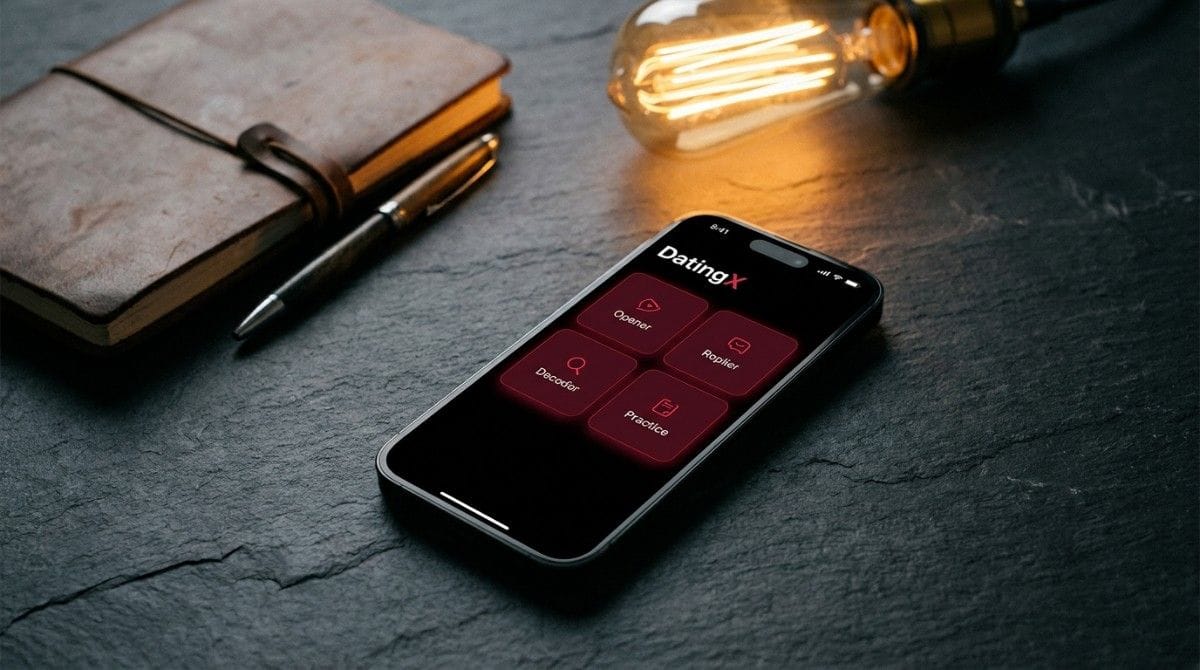
DatingX Is Built For The Augmentation Side Of The Line 🎯
If the 3-question test is the ethical baseline, DatingX is engineered to land on the right side of all three by default.
The product structure makes deception harder, not easier.
- 🔥 The opener generator generates multiple vibe variations (flirty, bold, mysterious, naughty), so you select the one that sounds like you rather than getting handed a single line to copy verbatim. The selection is yours; the AI just expands the menu of options.
- 🎯 The chat decoder helps you understand a message you received, you're not sending its output to anyone. There's no misrepresentation question because nothing is being sent in your name.
- 🧠 The voice-based date practice at practice.datingx.ai is rehearsal, not deception. Practicing what you'll say in real conversations is what athletes, public speakers, and interviewers all do. Doing it for dating doesn't change the category.
The honest pitch: the tools are designed so the version of you that arrives on the date matches the version of you that texted. That's the augmentation side of the line, and it's the side that holds up to the 3-question test cleanly.
📲 Download DatingX and 10x your dating game → datingx.ai
FAQ
Are AI dating chatbots considered cheating?
Not by default, and 2026 dating surveys consistently show ~60–75% of real daters accept AI for refinement and editing. The line gets crossed when AI is used to misrepresent who you are, fake a personality, or generate emotional vulnerability you don't actually feel. Polishing how you already sound is fine; fabricating who you are isn't.
Should I tell my match I use AI for dating messages?
Disclose when the relationship has reached a level of depth where small honesties matter (around 3+ dates), and frame it practically rather than apologetically. Light spellcheck-level use doesn't require disclosure. The clearest test: if you'd be embarrassed to tell your match, you're probably using AI in a way that crosses the line and should adjust the use, not the secret.
Is using AI to write dating app openers ethical?
Yes, in nearly all cases. Using AI to polish an opener you'd plausibly write yourself is in the same ethical category as having a friend read your message before you send it. The ethical question only appears if the AI is generating banter, vocabulary, or personality you couldn't authentically deliver in person.
What do most people think about partners who use AI dating chatbots?
Calibrated, not absolutist. Surveys show acceptance levels above 60% for editing and refinement use, dropping below 30% for verbatim copying or fabricated personality. The ethical instinct in the population mirrors the 3-question test: refinement is fine, replacement isn't.
Is using a companion AI while in a relationship cheating?
This is a separate ethical question from co-pilot AI use, and surveys show roughly 45% of partnered respondents consider sustained companion AI use a form of emotional infidelity. The verdict typically depends on disclosure and partner agreement. The fidelity question for companion AI is fundamentally different from the communication ethics question for co-pilot AI.