
Are AI Dating Chatbots Bad for You? The Honest Answer (2026)

The honest answer is: AI dating chatbots are bad for some people, fine for most, and genuinely useful for a smaller group, depending entirely on which type you use and how you use it. The category is not a single product, and the population-level evidence shows clearly that the risks split along usage patterns, not the technology itself.
This article gives the verdict most reviews avoid: which risks are real, which are exaggerated, and who should genuinely skip the category entirely.
TL;DR
- AI dating chatbots split into two categories with very different risk profiles
- 6 real risks include skill atrophy, parasocial attachment, and avoidance of real intimacy
- 4 exaggerated risks include "AI will replace dating," "you'll get addicted instantly," and "it ruins your authenticity"
- The decisive variable is whether you use companion AI (higher risk) or co-pilot AI (lower risk)
- 4 user profiles should skip the category entirely; most others can use it safely with a usage protocol

What Does "Bad for You" Actually Mean?
The phrase carries different meanings in different reviews, and most articles never specify which one they're answering. There are four distinct claims worth separating.
- Bad for your dating skills (skill atrophy)
- Bad for your mental health (attachment, isolation, depression)
- Bad for your real relationships (substitution, distorted expectations)
- Bad for society (broader cultural concerns about AI companionship)
Each has different evidence. Each applies to different users. Lumping them together is how this question keeps getting answered badly. The foundational guide on the two AI chatbot categories is essential context, the answer changes substantially depending on which type you're considering.
The 6 Real Risks (Evidence-Backed)
These are the concerns that hold up under research and clinical observation.
Risk 1: Skill Atrophy
What it means: Heavy reliance on AI for openers, replies, and decoding can erode the underlying skills, the same way GPS use weakens spatial navigation over time.
Evidence: Behavioral psychologists quoted in Fortune's 2026 coverage of AI relationships describe this directly: prolonged reliance on frictionless conversational tools "trains expectations of zero-friction interaction" that don't generalize to real social environments.
Severity: Real but correctable. The Atrophy vs. Augmentation framework for using AI dating tools is the established mitigation. Risk is substantial without a usage protocol, low with one.
Applies to: Heavy daily users, especially of co-pilot tools used as full substitution rather than scaffolding.
Risk 2: Parasocial Attachment To Companion AIs
What it means: Forming a real emotional attachment to a simulated partner, with the same neurological responses as a real attachment, but no actual person on the other end.
Evidence: Male Allies UK research highlighted in Fortune found 20% of teen boys aged 12 to 16 personally know a peer "dating" an AI chatbot, and 85% have spoken to one. Clinical reports of users grieving when companion AIs are updated or shut down (the 2023 Replika ERP rollback was the canonical case) confirm the attachment is functionally real.
Severity: Significant for heavy companion users. Negligible for co-pilot users.
Applies to: Companion chatbot users (Replika, Nomi, Character.AI, Flipped.Chat, Candy AI), not co-pilot users.
Risk 3: Avoidance Of Real Intimacy
What it means: Using AI companionship as a way to opt out of the discomfort of real human connection, rather than as a bridge into it.
Evidence: The psychology behind why people are dating AI chatbots instead of real people maps this dynamic in detail. Researchers describe the appeal as "maximum control, zero rejection," which is structurally an avoidance pattern, not a preference.
Severity: High for users already showing avoidance patterns in real dating. Low for users who haven't.
Applies to: Users with existing rejection sensitivity, social anxiety, or attachment avoidance, particularly those using AI to bypass real-world reps rather than supplement them.
Risk 4: Distorted Expectations Of Real Partners
What it means: Calibrating to AI partners (always available, always agreeable, no autonomy) makes real partners feel comparatively difficult, even when they aren't.
Evidence: Same Fortune-cited research finding 58% of teen boys cited "easier conversation control" as the appeal, the implicit baseline being that real partners are harder. When that baseline becomes the user's default expectation, real-world dating feels worse than it is.
Severity: Real for heavy companion users, particularly younger users still forming relationship expectations.
Applies to: Users in formative dating years (especially under 25) and users using companion AI for many hours per week.
Risk 5: Privacy And Data Exposure
What it means: AI dating tools collect intimate conversation data. Companion bots retain emotional disclosures. Co-pilots receive screenshots of real conversations with real matches.
Evidence: This is industry-wide, not specific to any single product. Most AI dating apps store conversation data for model improvement. Some have had documented breaches. Most users don't read the privacy policies.
Severity: Moderate. Lower for users who avoid sharing identifying information or sensitive disclosures.
Applies to: All users of all AI dating tools to some degree. Higher for companion users (more intimate data) than co-pilot users (transactional data).
Risk 6: Financial Drift
What it means: Subscription stacking. Many users end up paying $20 to $60 per month across multiple AI dating tools and companion services without realizing the total.
Evidence: Self-reported across multiple subreddits and reviews; the typical heavy user runs 2 to 3 simultaneous subscriptions.
Severity: Low to moderate. Trivial financially for most adult users, but worth flagging.
Applies to: All users; most pronounced in users sampling multiple tools.

The 4 Exaggerated Risks
These are concerns that show up constantly in coverage but don't survive close examination.
Exaggerated Risk 1: "AI Will Replace Real Dating Entirely"
The claim: AI partners will become so good that real dating dies off.
Reality check: Population-level evidence shows AI use is rising alongside continued dating-app use, not replacing it. Match's 2026 survey found ~50% of Gen Z uses AI for dating support, but real dating activity hasn't dropped proportionally. The substitution risk applies to a specific user profile (covered below), not the general population.
Exaggerated Risk 2: "You'll Get Addicted Instantly"
The claim: AI dating chatbots are inherently addictive and grip users from the first session.
Reality check: Most users report a novelty arc, intense for the first 1 to 3 weeks, then tapering. The minority who develop sustained heavy use show pre-existing patterns (loneliness, social anxiety, attachment style) that pre-date the tool. The tool amplifies existing patterns rather than creating them.
Exaggerated Risk 3: "It Ruins Your Authenticity"
The claim: Using AI to draft messages makes you a fake version of yourself.
Reality check: This is the most common objection and the one most thoroughly addressed by the dedicated authenticity analysis. The short version: editing AI suggestions to sound like you is no different from rehearsing what to say to a friend. The unauthenticity question is real only when you copy verbatim and misrepresent your own conversational style, which the same usage protocol from Risk 1 prevents.
Exaggerated Risk 4: "It's Worse Than Just Asking A Friend"
The claim: A human friend's advice is always better than AI suggestions.
Reality check: A friend might be better at emotional support but is generally worse at pattern recognition across thousands of dating conversations. AI co-pilots are also available at 2am, don't gossip, and don't have their own dating biases bleeding into your decisions. Friends and AI serve different functions, neither replaces the other.
Statistics & Research Insight
Three data points worth holding together when evaluating risk:
| Source | Finding | Risk Implication |
|---|---|---|
| Match 2026 survey | ~50% of Gen Z uses AI for dating support | Mainstream use; population-level risk is moderate |
| Male Allies UK / Fortune 2026 | 20% of boys 12–16 know a peer "dating" an AI chatbot | Substitution risk concentrated in younger users |
| Fortune-cited behavioral research | 58% cite "easier control" as the appeal | Avoidance pattern, not preference; flags Risk 3 |
The takeaway: at population scale, the category isn't more dangerous than social media or dating apps generally. At individual scale, the risks concentrate in specific user profiles that the next section identifies.
Who Should Skip AI Dating Chatbots Entirely
Four user profiles for whom the honest answer is "don't use this category."
- You're under 18. The category isn't built for you, the formative-years risk on distorted expectations (Risk 4) is highest in this cohort, and most platforms have terms-of-service age restrictions for good reason.
- You're in active recovery from relationship trauma or attachment-style work with a therapist. The avoidance dynamics (Risk 3) can compound therapeutic work in ways that aren't obvious until you've already made progress harder. Talk to your therapist first.
- You have an active history of compulsive technology use (gaming, social media, gambling apps) that you're working on. The same dopamine architecture applies, and the personalization layer can intensify it.
- You're in a committed monogamous relationship and considering using companion AI as romantic content. Relationship therapists are increasingly flagging this as a fidelity-adjacent issue. Talk to your partner first; don't decide unilaterally.
For everyone else: the risk is real but manageable, particularly with the co-pilot category and a basic usage protocol.

The Co-Pilot vs. Companion Distinction (Why It Matters For Risk)
Most articles answering "are AI dating chatbots bad for you" conflate the two categories. The risks split sharply along category lines.
| Risk | Companion AI (Replika, Nomi, etc.) | Co-Pilot AI (DatingX, Rizz, etc.) |
|---|---|---|
| Skill atrophy | High (no real-world reps) | Moderate without protocol, low with one |
| Parasocial attachment | High (the entire product is attachment-based) | Negligible (no character to attach to) |
| Avoidance of real intimacy | High | Low (tool requires real conversations to function) |
| Distorted partner expectations | High (frictionless AI as baseline) | Low (real matches stay real) |
| Privacy exposure | Moderate to high (intimate disclosures) | Moderate (transactional conversation data) |
| Financial drift | Moderate (subscription, sometimes credits) | Low (typical $1.34 to $7 per week) |
Key Insight: The honest answer to "are AI dating chatbots bad for you?" depends almost entirely on which type you use. Companion AI carries five of six real risks at high severity. Co-pilot AI carries one at moderate severity (skill atrophy, mitigated by protocol) and the rest at low. The category-level question is the wrong one. The category-specific question has a clear answer.
For the population-level decision framework on companion vs. co-pilot, the ranking of all 9 major AI dating chatbots across both categories is the practical companion piece.
Quick Framework: Should You Use One?
A 4-question decision framework.
- Are you in any of the four "skip entirely" profiles above? If yes, skip. If no, continue.
- Are you considering companion AI or co-pilot AI? If companion, the risk profile is meaningfully higher. Read 15.2 first. If co-pilot, the risk profile is manageable.
- Will you commit to a usage protocol? Drafting your own attempts first, editing AI suggestions, taking tool-free days. If yes, the skill-atrophy risk drops sharply. If no, expect drift.
- Will you pre-commit to canceling if usage rises month over month for 6+ weeks? This is the simplest tripwire against drift. If you can't commit to it, the financial and dependency risks rise.
Three or four "yes" answers means you're in the population for whom the category is safe and useful. Fewer than that, reconsider.
Final Takeaway
AI dating chatbots are not categorically bad for you, and the writers claiming they are have usually conflated companion AI and co-pilot AI into a single risk profile. The honest answer is more specific: companion AI carries real, well-documented risks that are highest for younger users and users with existing avoidance patterns. Co-pilot AI carries smaller risks, mostly mitigated by basic usage protocols.
The category question is the wrong frame. The specific question, "is this type of AI dating tool bad for me, given this profile?" has a clear answer for most people. For most adults using co-pilot tools with a usage protocol, the answer is no. For some specific user profiles, the answer is yes, and the article above lays out which ones.
Pick the category that matches your real goal, follow the protocol, and the question disappears.
DatingX Sits On The Lower-Risk Side Of The Map 🎯
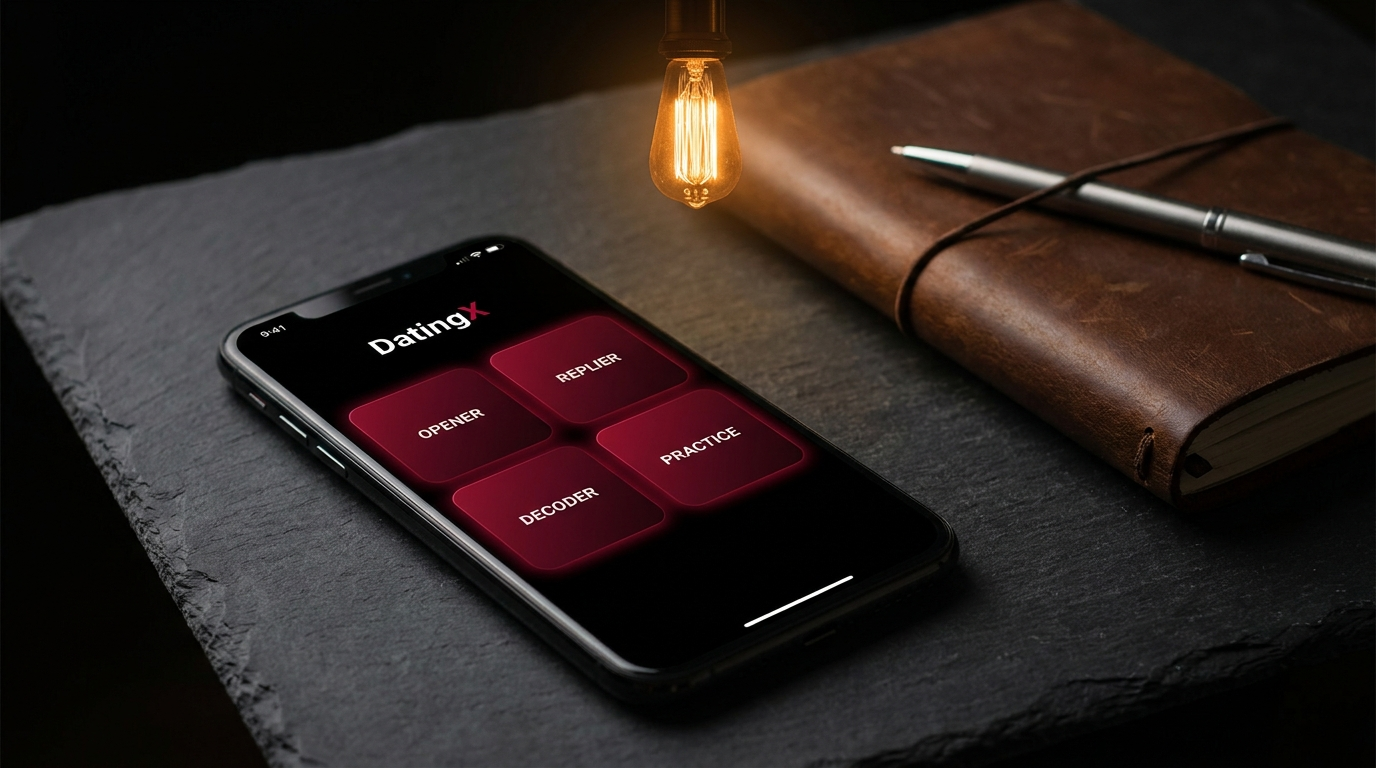
If you've read this far, you already know the category that carries the real risks is companion AI. DatingX is in the other category, deliberately.
It doesn't simulate a partner. You can't fall in love with it. It can't replace the people you talk to. It's a co-pilot built specifically to lower the cost of real-world dating, not to substitute for it.
Three things DatingX does that keep it on the lower-risk side of every framework above:
- 🔥 The chat decoder reads real conversations from real matches and trains your pattern recognition, returning compatibility scores, green flags, red flags, and recommended next moves so you learn what to look for over time
- 🎯 The opener generator generates multiple vibe variations (flirty, bold, mysterious, naughty), training your ear for what works rather than handing you one line to copy verbatim
- 🧠 The voice-based virtual date practice at practice.datingx.ai is the only feature in this category that builds in-person muscle memory, the exact opposite of the skill atrophy concern
The honest pitch: DatingX is engineered to be a tool you eventually need less of. That's the entire design intent. Try it as augmentation, follow the basic usage protocol, and the risks listed in this article stay theoretical.
📲 Download DatingX and 10x your dating game → datingx.ai
FAQ
Are AI dating chatbots actually bad for you?
Some are, some aren't. The risks split sharply between companion AI (Replika, Nomi, Character.AI, Flipped.Chat, Candy AI) which carries higher risks of parasocial attachment, distorted expectations, and avoidance of real intimacy, and co-pilot AI (DatingX, Rizz, YourMove) which carries primarily skill-atrophy risk that's mitigated by a basic usage protocol. Lumping the two together is how this question keeps getting answered badly.
Can AI dating chatbots make you lazy at real dating?
Yes, if used as substitution rather than augmentation. The risk is real but correctable through a usage protocol that includes drafting your own attempts first, editing AI suggestions before sending, and taking regular tool-free days. With the protocol, skill atrophy is minimal. Without it, atrophy is the most likely long-term outcome of heavy use.
Are AI girlfriends or boyfriends harmful?
Companion AI carries the highest risk profile in this category. Documented concerns include parasocial attachment (functionally real even though the partner isn't), distorted expectations that make real relationships feel comparatively difficult, and avoidance of real-world dating reps. The risks are concentrated in heavy users, especially under-25 users. Light or recreational use carries lower risk.
Who shouldn't use AI dating chatbots at all?
Four profiles: anyone under 18, anyone in active recovery from relationship trauma, anyone with an active history of compulsive technology use, and anyone in a committed monogamous relationship considering companion AI as romantic content. For everyone else, the category is generally safe with sensible usage.
Is using AI to text on dating apps cheating or unethical?
The honest answer is no, in the same way using spellcheck or rehearsing what to say to a friend isn't cheating. The line gets crossed only when AI suggestions are copied verbatim and misrepresent your real conversational style, which a basic usage protocol prevents. Using a co-pilot tool to refine messages you'd send anyway is straightforwardly fine.